Tuesday, August 14, 2018

Comedy and Community


“A word from the audience, please.”

We shout, “chicken nuggets!”

And so the improv begins, using chicken nuggets to create scene after scene. We could have yelled shoelaces and the scenes would have been just as funny but utterly different. The actors took no time at all to think of the next interaction they would concoct. That type of confidence and fast planning was the first indicator that we were about to see some dynamic improv. That, and the fact that the theatre taught classes- if these folks were knowledgeable enough to not only do it themselves but encourage improv in others, then exciting things were in store. 

Improv trades on being Interactive; it feeds off its audience, whether that’s through laughter, requested prompts, or volunteers. The atmosphere in the Improv Comedy Copenhagen (ICC) theatre was eager and electric. Perhaps it was because it was a Friday night, or their cozy bar, but there was a vibrancy and warmth that I had never felt at an improv show before. The Second City improv troupe in Chicago, a training ground for stand up comedians and Saturday Night Live actors, builds a relationship between actors with each playful risk they take. For ICC that playful risk felt like it included more than just them- it involved the audience. It achieved this through its intimate setting of about 25 seats- all of which were filled. There was no room to not feel up close and personal with the actors. In addition, pictures of the actors in wacky poses adorned the wall like family photos, showcasing their different events and immortalizing funny moments. At the introduction they advertised a special program they do on Fridays, in which the audience gets to improvise on stage and play with the performers after the show.  And since the crowd knew right away that they’d be able to put themselves out there as much as the performers did, a supportive welcoming space was brewing. The actors were encouraging and kind, including convenient bathroom/drink purchasing interludes they built into the show so that audience members could meet each other and bond over what they had just seen. 

Within the audience were a mixture of people, some Danes and others students, some relatives and others newcomers. Since the troupe used English instead of Danish, it already had a inclusive vibe towards visitors but also to second language Danish speakers of all kinds. A recent immigrant to the country was telling me about how her husband joined the theatre to get to know people in Copenhagen. Another audience member, asked me whether I was taking classes at ICC. She told me that she had been taking lessons and was there to see her teachers perform. This really was an intimate gathering of family and friends. This is not to say that things did not fall flat in this environment. There were moments where I was left scratching my head or unable to laugh. The fact that they risked failure and vulnerability in front of people was the best part. One could watch them fail, learn, and try again, inspiring a resilience in the crowd as well. 


Now onto the performance itself. The first actress revealed her comradery with her sister during her parents divorce in a sad but funny opening monologue. And they just kept hitting on real problems throughout the show, from generational differences, depression, religious issues, to vegetarianism, and puberty. There was never a dull moment with vegan sons, apocalyptic dads and cult squatters in an Italian restaurant. This may sound nonsensical to people who weren’t at the performance but reoccurring inside jokes and subtle facial expressions are why this comedy was a success. They built a sense of shared experience from the ground up and during the breaks one couldn’t help but recite favorite lines like Mag-del-ena said in a slow drawn out fashion so that someone across from you knows to say it aloud with you despite not knowing the word. A particularly special moment was when two men started kissing on stage, but not in a way that was making fun of sexuality but in a way that it could have been any two people kissing, however after swirling imaginary drinks for weeks, romance was the funniest and most unexpected thing you’d suspect to take place. It was a wise choice to pick up the pace with short improv games in the second half of the performance because people were warmed up to the form and ready for some variety and participation. Although ending with pickup lines was more vulgar than the rest of the show’s tone that wasn’t enough to detract from the overall engaging performance that would certainly have repeat customers.

Visual Excellence and Narrative Fault in Cathleen Naundorf's "Arche de Noé"

The Fotografiska, a Stockholm museum of contemporary photography, is truly a gem among the city’s many shining artistic monuments. In a modest waterfront property on the Sodermalm north coast, the museum hosts seven exhibits of varying tone, all neatly displayed. One could write much as to the effectiveness of the museum’s organizational, aesthetic, and selective abilities. However, this review serves to discuss a weak point in an otherwise strong repertoire. That is not to say that Cathleen Naundorf’s Arche de Noé, a gallery within her full exhibit, Secret Times, was a poor or ineffective work—merely that the gallery’s conviction failed to live up to the impressions of the rest of the exhibit and museum.

Cathleen Naundorf, German-French graphic designer and photographer, has over 20 years of experience working with “legendary haute couture fashion houses,” per the Fotografiska’s website description. There is no doubt that she occupies a position of prominence within the world of fashion for her photographic ability and experience. She has published 8 books, and her work in photojournalism has taken her to locations including Mongolia and the Amazon with the likes of the Dalai Lama and photographer Horst P. Horst.

Naundorf’s Secret Times, installed in May 2018, features “breathtaking photos of beauty, mystery and divine lighting.” Different segments of the exhibit feature black-and-white, tampered film, portrait, and landscape photography, all rather elegantly combined into a seamless and sensical experience.

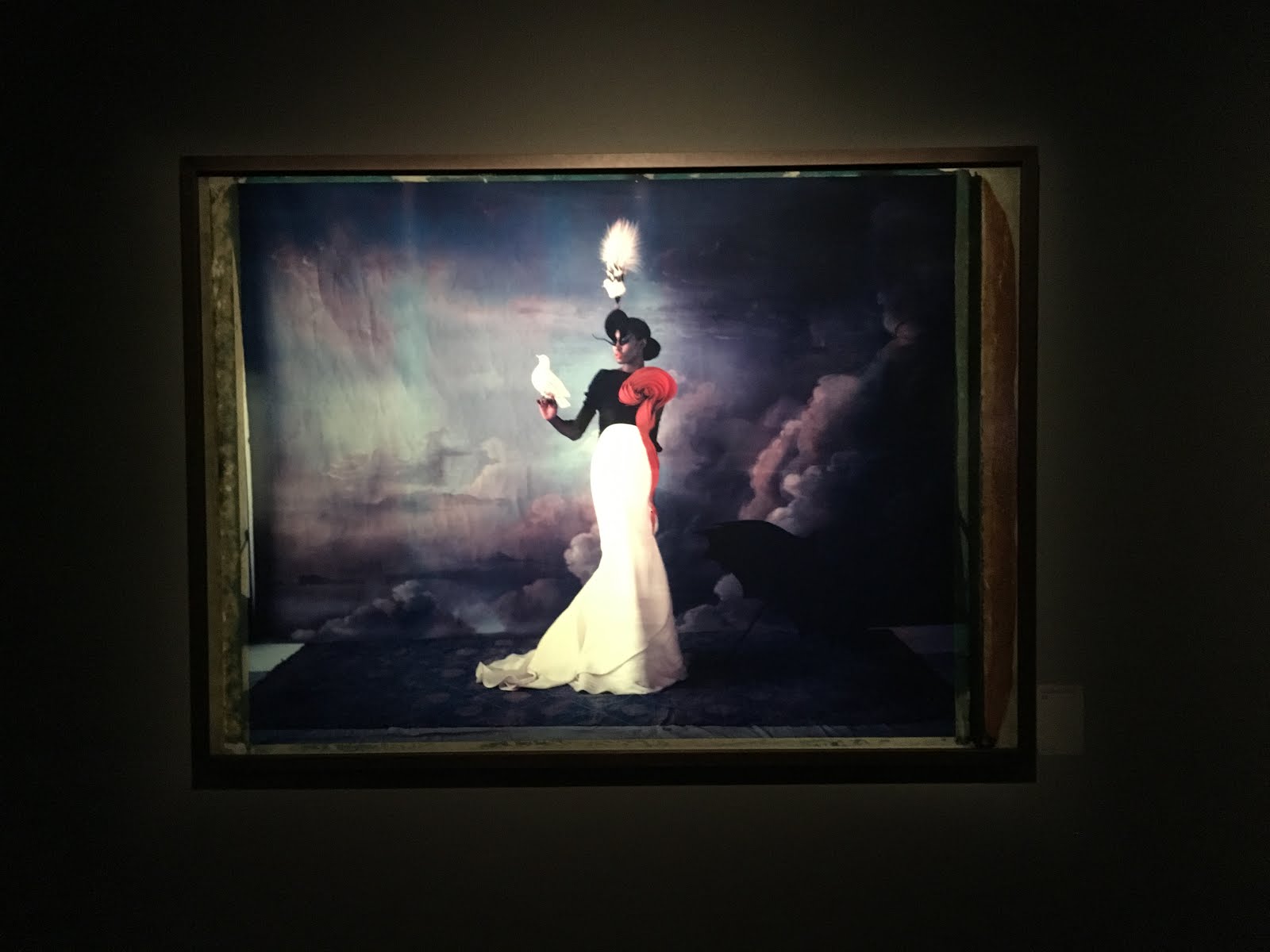
Within, Arche de Noé is an eight-photo gallery depicting the artist’s vision for the Biblical tale of Noah’s Ark. Per the display’s posted description, Naundorf “freezes time in a moment of storytelling and at the same time takes us on a voyage of discovery through her artistic universe.” The original Biblical tale recounts the creator’s decision to end the world as it was and start anew, and His choosing the prophet Noah to build an ark to house the survivors. Noah does so, bringing a pair of every species onboard, and God promptly ends the remainder of existence in an enormous month-long flood.

Naundorf’s exhibition features models in haute cotoure fashion pieces from industry-leading designers like Dior or Philip Treacy, intended to juxtapose with the Biblical tale and the feelings of struggle and rebirth it manifests. In Naundorf’s own words regarding the display, “I am telling the classic Bible story, Noah’s Ark. Saving the animals and mankind; leaving Earth as we know it—in a boat—and believing there is something better for the future.”

Several photos from the exhibition are included below:


There is a lot that this gallery achieves effectively. First, Naundorf eschewed digital editing, and the entirety of the lighting, contrast, and color palette are accomplished by her own staging and film preparation. It is impossible to deny the incredible skill associated with this undertaking. The color scheme is consistent and gathers attention appropriately in each photo. The models seem to blend into the backdrop while still popping out to the eye, an effect shared with effective portrait painting. The birds are quite masterfully featured, as homage to the Biblical tale, and the models expressions are compelling and inquisitive, drawing in the viewer’s attention.

There are, however, aspects of the photos’ composition that detract from the exhibit’s narrative strength and immersive potential. The first is a deficiency in image framing, such that regions of the photos appear “out” of the scene—the corners of the carpet, the scaffolding that supports the backdrop, the white plaster wall behind. It’s the “boom mic in the shot” trope applied to still photography that takes the viewer out of the narrative. While an indoor, highly-equipped photography studio was likely necessary for the photos’ excellent lighting, focus, and color, the audience need not be reminded of that fact—much like a fourth wall break in narrative film.

Further, the elegant and delicate portrayal of haute couture fashion, manicured hairstyles, and pompous poses clash with what is ultimately a Biblical tale of wrath and systematic destruction. While the images may succeed in capturing the dualism of the flood’s gloom and optimistic intent, the story is no elegant affair. There’s something untrue about this roofed, propped, and staged retelling—perhaps more accurately told in the wind and rain, with desperation and dynamic movement present in the models’ posture and expression; the birds in flight.

While beautiful, the photos in this gallery should abandon the Noah’s ark narrative and stand alone as a tour de force in photographic excellence. Conflating the beauty and perfection of Naundorf’s vision with the erasure of an entire pre-Biblical world is distracting and ineffective. Entering in without the narrative expectation, visitors should expect to enjoy an aesthetically compelling gallery within a wonderful exhibit and greater museum.

Monday, August 13, 2018

Adjusting to "The Swing of Things"


Designmuseum Danmark aims to be an archive for art that embodies the principles of Danish design—minimalism, functionality, and beauty. Upon first glance, the museum accomplished this goal. Rooms were filled with bright colors and whimsical furniture complemented by sleek ceramics in soft pastel tones. However, the more time I spent exploring the museum, the more I recognized a lack of logical flow and cohesion between various rooms and among the artifacts themselves. One minute I was looking at Danish fashion, and a few steps later I was attempting to appreciate the architecture of wooden desks from 17th century England. That a design museum would be so poorly designed was so ironic it was nearly comedic.
As a result of the careless layout, the museum as a whole failed to convey a compelling narrative. There was, however, one piece of art that I found intriguing. It was a white pillow case that had a grayish-brown dusty film over it making it look as though it had not been washed for months. In the middle of the pillow case was a facial imprint that could have been mistaken for wrinkles had the description not stated “Pillow with facial imprint.”
Though the facial imprint was odd, eerie even, the true horror of the art piece was the the embroidery at the top of the pillow case. Artist Pernille Egeskov stitched the words “The swing of things” using fine brown human hair as the thread. Egeskov completed a few stitches with each piece of hair and left the rest to hang freely on the pillow. She used a small chain stitch that, though uneven, showcased a greater level of care and detail than the rest of the piece. Like the facial imprint, the embroidery could have easily been overlooked. It resembled a matted hairball that had dried on the bottom of a bathtub: there was a concentrated center made of chaotic strands that curled outwards in free-flowing, haywire patterns. Seeing this caused my whole body to wince in disgust and triggered a gag reflex. I noticed other viewers had similar reactions. Human hair, especially when detached from the scalp, is commonly considered to be unhygienic. This thought stems from the fact that hair traditionally serves as a carrier for unwanted critters such as lice and nits. Perhaps this is why seeing large quantities of hair on a pillow—a sacred space for the face—was far more appalling than seeing the hair on a different object.
Despite my negative reaction to the art piece, I harbor respect for Egeskov’s creativity. I am also impressed by the intense, though negative, reaction her work was able to quickly evoke. However, The Swing of Things did not belong in Designmuseum Danmark. It clashed with the museum’s aesthetic of clean, simple, and traditional design. Egeskov’s work was displayed in the Sustainable Design room, but even the curators seemed to be hiding it. The pillow had been placed in a glass cabinet that was shoved to the side. There were no lights above the glass cabinet to illuminate the artifacts inside. Instead, all of the lights were situated above the grand display of chairs and sculptures in the center of the room; the rays emanating from these sources barely hit the cabinet, causing the pillow to be dimly lit. To make matters worse, large shadows fell on the pillow at strange angles, masking the artistry.
The Swing of Things was most certainly nauseating, but it was also the most curious and enticing artwork in Designmuseum Danmark. It added energy and emotion into an otherwise bland atmosphere. Perhaps it is the museum’s hidden gem saved for the observant eye.  


‘Chicken Nugget?’: Vim and Profundity in Improv Comedy Copenhagen’s Friday Show

The tiny, 32-seat theater that houses Copenhagen’s only improvisational theater company belies the splendor of their comedy. With quick wit and inventive storytelling, the cast of Friday’s show at the Improv Comedy Copenhagen (ICC) wowed its audience with a riveting feast of humor that skilfully avoided the usual pitfalls of improv comedy as it explored some of life’s most poignant moments. From heartbreak to hearthrob and much between and beyond, the show was a rich, wild journey through universal experiences of belonging and longing. Rarely did the actors resort to lewd humor.
The showed featured both long-form and short-from improv. In the first half, the players performed a series of vignettes threaded together by a suggestion from an audience member who was loudest and fastest to shout their idea amid a throng of others. “Chicken nuggets” won the attention of the first improviser, who opened the show with a heartfelt monologue that traced the origins of her distaste for the children’s poultry product. What began as a humorous excavation of the mediocre taste of chicken turned into a thoughtful reflection on her parents divorce, and how the two were now inextricably linked. She delivered her monologue without pausing to say “um.” The audience sat awed at her integration of an innocuous suggestion, empathized at the trauma of the divorce.  
These unexpected plot lurches performed the bulk of the comedic work. In one scene between two men, the first actor opened the dialogue in a deep, macho voice, “Hello, Mr., we meet again,” holding in his hand a sword with which to spar. His partner replied nonchalantly, taken aback at the sword. “Uh, yeah, we do.” The first character took this as an opportunity to change the direction of the scene: “I’m sorry I didn’t remember your name, dude, I’ve been on a lot of grindr dates.” A pause. “Dave,” his partner replied. “Right, Dave.” It got a huge laugh. As the scene progressed, the warrior-turned-bachelor continued to reference previous “forgotten” encounters between the two; gradually they built sexual tension until a charged kiss became full-throttle making out, nearly tackling each other in lust. In a later scene, a Vegas magician appeared mysteriously in the bedroom of an ordinary man, apparently following up on a promise made during a performance that he would dramatically alter the course of his day tomorrow. After much confusion from this ordinary man, the magician divulged an ulterior motive: he needed a loan. Suddenly, our empathy for the confused man turned to pity for the financially desperate artist.
Unlike the bawdy humor of much contemporary improv –– humor enabled by a male-dominated industry –– the laughs in Friday’s show stemmed from the deeply human desires of full-fledged characters grappling with life transitions and difficult cultural moments. This was striking given the cast was comprised of six men and only one woman. The second vignette in the long form stood out for its ability to capture the fraught swirl of emotions for millenials who’ve inherited the problem of climate change from our parents’ generation. This same vignette highlighted the absurdity of gun rights activism by depicting a father giving his young son a gun to fend off enemies in a post-apocalyptic world. Only when male actors portrayed women characters did they resort to gendered stereotypes. In the one such vignette, a male actor playing a hubris teenage girl exploited stereotypes of femininity to build his character: he flaunted his boobs, twirled his hair, and stuck out his buttocks as he explained to his younger sister what to expect from puberty. It was a low point, redeemed only by the delightful absurdity of the rest of the scene. The women characters created by the woman actor contained more depth. At various times she was the struggling daughter, the goddess of a mythical religion, and the empty narrator telling a story she wished was her own. I hope ICC will take a note from her vivid illuminations of complex women characters.

Moving Along: Rob Norman’s Dynamic Improvisation


On Friday, August 11, 2018, I entered the International Comedy Copenhagen theatre, a cozy one-room affair on a cobblestone street in the old part of Copenhagen. I sat in the front row, and all the rows of folding chairs behind me quickly filled. The lights dimmed, and a gray-haired man came onstage, where he announced his fellow improvisors in a chipper British accent, with a special note that the mostly Danish cast would be joined tonight by a well-regarded improvisor from Canada, a Rob Norman.

            I have seen improvisation shows before, and so I thought I knew what to expect: fumbling plots, somewhat-offensive stock characters, crude humor, and absurd scenes that dragged on for too long. I thought that these drawbacks were just part of the condition of improvisational comedy, and were worth it for the delight of seeing people invent worlds on the spot. But the show that now unfolded before me far exceeded my expectations.
            The scenes, though separate, played off of each other. Characters came back at unexpected and hilarious moments. The scenes didn’t all take part in a world of extreme absurdism; some felt very real. Each scene had dynamism and plot, and wasn’t given time to droop or stagnate, before a new scene would begin. The cast worked wonderfully with each other, and each had good ideas, but the star of the show was clearly the Canadian guest, Rob Norman. This did not mean that he dominated the show. Instead, he offered ideas in participation with the other actors. His characters, from the beginning, were fully embodied. They had body-language, and agenda, and a physical place in space: with a few mimed motions he made it clear that he was in a kitchen, getting a beer from the fridge, or getting ready in front of a mirror, whereas the other actors often had scenes that floated in a nowhere space. I hadn’t known what made for truly great improvising until I saw two scenes in which Rob performed alongside another actor.
            In one, an actor began by pretending to urinate in the direction of the audience, and Rob came in as an over-eager bathroom attendant. Each time Rob spoke, he moved the story, either escalating its absurdism, or changing the direction of the plot. His scene-partner tended to take the cues and play more of the bewildered ‘everyman,’ responding to Rob in a way that maintained but did not move the narrative. I have observed that it is easy for improv to fall into a back-and-forth plateau, in which the current situation drags on, perhaps becoming slightly more farfetched, but not in any way that is truly surprising or delightful. Rob surprised and delighted with every line.
            Another scene in which Rob shone was one in which he started by sitting in a chair, and the older British fellow came in, looking baffled and distressed. So: the British fellow had given the first emotional cue, the offer for starting the scene.
            Rob sat back coolly in his chair and said, “You’re confused.”
            “Well, yes,” spluttered the British man. Rob waited unless the British man was going to explain himself, but he didn’t seem to have anything more to say, so Rob forged on ahead.
            “You’re wondering how I got in your house,” said Rob. “Why I’m sitting on your bed.”
            And this went on, with Rob offering suggestions. He always gave space for his scene partner to speak, but his partner ended up mostly spluttering, so it was up to Rob to move the scene along. This was the most dynamic scene of the improv show. With each line, Rob revealed a new layer to the story. He was a Las Vegas magician. He had seen this fellow in the audience of the show. He had stolen his identity. He had emptied his bank account and cavorted with his wife and now he was moving into his house.
            Here, again, Rob gave space to his scene partner, but the scene partner was at a loss for words, so Rob held out a mimed set of cards and said, “Pick a card.”
            The scene partner splutteringly obliged, and then Rob said, “That’s for a divorce lawyer. You’re going to need it.”
            At this, the audience, including me, burst into laughter and applause. Perhaps in a regular play, the joke would have been merely funny, but knowing that it had been concocted just moments before made it hilarious. Soon after this, that scene ended, before we could get weary of it, and the show moved onto other things.
 I do not wish my praise of Rob to belittle the other actors. They were all expressive, quick-thinking, and cooperative. Throughout the show, their incorporation of audience suggestions, combined with the intimacy of the venue, made it feel as if the audience were an essential part of the action onstage. However, it was Rob who really showed me the dynamic possibilities of improvisation: that the best improv could be like a tightly-written story, where each line had purpose and contributed to the movement of the piece.
            At the end of the show, the cast held an ‘improv jam,’ in which audience members could come on stage and try improvising with some of the experienced cast members. At first I had no intention of volunteering, but after watching some fellow amateurs fumble around, I had enough confidence to give it a try. I did not move along the scene with my every line. My character was not complex or particularly embodied in space. But I found it exhilarating and comfortable to be up on stage. It reminded me of the joy of make-believe play as a child. Trying improv myself drove home just how much there was to learn, and made me eager to try again, or at least to catch Rob Norman on his next tour.