Friday, August 10, 2018

Beauty and Devastation: Dilemmas in Kent Klich’s “Gaza Works”


Today I visited the Danish Royal Library to view Kent Klich’s photojournalism exhibition, “Gaza Works.” I crossed the library lobby with its bright views of boats on blue water, and descended an austere gray staircase. I found myself in a dim and cavernous room with no windows. Intermittent shrieks and unintelligible shouting reverberated from some unknown location. Never, in that room, was I able to mentally escape the curated experience of desolate Gaza for the comfortable Copenhagen I knew rested above me. Always the uncomfortable background noise and dim, echoing space kept me anxiously engaged in the material.

In a statement at the beginning of the exhibition, Danish photojournalist Kent Klich explains that he aims to reterritorialize the mainstream narrative of the Gaza experience. Rather than offering short-term and sensationalist snapshots of disasters, he asserts that he has formed a more collaborative relationship with residents of Gaza, and thus has a different story to tell, one that humanizes Gazans and portrays a long-term struggle. In some ways, I found that Kent Klich delivered his intention, while other aspects of his exhibition were unintentionally alienating.  

The exhibition was divided into segments. There was a brief collection of black and white photographs of Gazans carrying their dead relatives, shouting and waving flags in rubble-strewn courtyards––the kinds of photographs I often see in sensationalist journalistic pieces. The largest segment of the exhibition was given to lamenting the loss of Gaza’s airport, of which now survived only a barren stretch of dirt, a few permanently-grounded airplanes, and some shards of mosaic flooring, which Klich displayed in a glass case. It was illuminating to learn about the demise of this airport, of which I had never heard of, and so in this respect Klich delivered on his promise to illuminate previously underreported facets of the Gaza experience. However, because the abandoned-airport photographs featured no human beings, and little accompanying text, I found it difficult to feel a genuine emotional connection.

The next segment also featured stark desolation. This was a collection of beautifully composed photographs of empty homes damaged by IDF raids. Here, an abandoned room with ceiling half-caved in, bullet-riddled walls, and armchairs bleeding stuffing suddenly became a work of art: the light, color, texture and arrangement of each photograph appeared deliberately composed. This mastery of craft, combined with a lack of human presence, lent the photographs a stark and unsettling beauty that seemed to me to subvert Klich’s intention of humanizing Gaza residents. These photographs were so clearly Klich’s work: a celebration of his mastery as an artist, even as they exposed ruin in hopes of eliciting audience’s political sympathy. Other segments also featured abandoned, precisely composed, artistically striking photographs: some of mammography machines, lamenting the lack of access to gynecological health in Gaza, some of the desert landscape after the so-called Black Friday conflict. These photographs, though compelling in their visual arrangement, resisted emotional involvement through their lack of human subjects.

For me, the most successful segments of the exhibition were the ones in which Klich’s role was less dominant, and the faces and voices of Gaza residents could shine through. The most emotionally moving segment of the exhibition, and the one in which I believe Klich fully realized his intended artistic mission, featured photographs that he did not take himself. This segment featured a long wooden table on which were arranged family photographs donated by various Gaza residents. From the table, people smiled with birthday cakes and wedding dresses, young men laughed on street corners, faded sepia people stared unsmilingly in the style of the day. Here were the people of Gaza, as I had never before seen them. The pictures bore a striking resemblance to my own family’s photos. These people––whom I normally only see present in the images of waving guns and flags, or absent, as in the carefully composed photographs of bombed buildings––now seemed real and breathing and human.


A collection of family photos from Gaza residents, displayed in “Gaza Works.”

Another successful segment also elevated the voices of Gaza residents. This video installation was entitled “Killing Time” and featured camera-phone videos taken by Gazans who were later killed in IDF raids. The videos are grainy, clearly amateur, and yet deeply moving, because we knew the subjects were headed for death. Men played soccer; a journalist waited at a police station; a young girl giggled with a garden hose. And here, finally, was the source of the intermittent shrieks that had persisted throughout the exhibition: a man swung a child playfully over a squawking, crowing rooster. This was nothing like the scene of suffering I had been envisioned when I heard the noises upon entering the exhibition. Instead it was a moment of play which further humanized Gazans for me and tilted my preconceptions of the Gaza experience.

In addition to illuminating parts of the Gaza experience about which I was unaware, “Gaza Works” challenged my notions of the genre of photojournalism. While I admire beautifully composed photographs as works of art, I found that when the photographs feature a peoples’ circumstance, without the people themselves, it can unintentionally exoticize the experience. It calls to mind when National Geographic used to feature photo-spreads of African tribes alongside photographs of rare animals, offering both for aesthetic consumption as exotic subjects. Instead, I admired Klich’s methods in the family-photo display and the video installation, in which he collected voices and images of peoples’ lives as they experienced them, therefore amplifying, rather than exoticizing, marginalized voices.

Klich’s work was clearly well-intentioned, and succeeded well in the segments in which it amplified Gazan’s voices; I only wish it had featured more clear evidence of collaboration with Gazans, such as quotations from interviews, or even portraits of their faces. Though imperfect, “Gaza Works” is a moving and thoughtful work of photojournalism by a skilled artist, and ultimately succeeds in further exploring and bringing to life a controversial contemporary topic.   

Øl and Jazz: The Intersection of Cultures


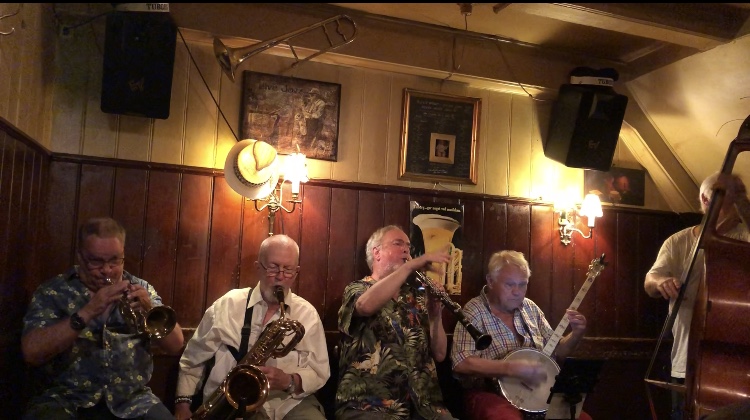
Entering Cafe Hvide Lam felt like stepping back into time. Sconces attached to the muted yellow walls softly illuminated rickety wooden furniture. The air was thick, saturated with the sweet smell of tobacco. Old Danes, at least in their late sixties, filled the bar, gaily drinking topped glasses of beer as they clapped along to the live music played by Danish jazz band Helge Kaj’s Trio and Friends.
Historically, jazz is an American art form -- often considered America’s only musical invention. Developed by African American communities in New Orleans during the late 19th and early 20th centuries, jazz vibrantly amalgamates blues, ragtime, and marches. A key characteristic of jazz is improvisation, which ultimately gives it the potential to spontaneously absorb influences from other genres. Renowned jazz musician Herbie Hancock stated, “jazz easily morphs and adapts and adopts various influences. It’s so open-ended. We welcome the influences from other genres of music, music from other cultures.”
Helge Kaj’s Trio and Friends paid homage to jazz’s history by beginning their set with a traditional jazz tune, Royal Garden Blues, soon developing improvised melodies. The five instruments, clarinet, trumpet, saxophone, banjo, and bass, intertwined and layered over each other, resulting in a free-flowing dialogue among the players. Even when one of the musicians wasn’t playing, he was responding to his bandmates through the tap of his foot, sway of his body, gesture of his hand, nod of his head. The band’s internal conversation evoked sentiments of lunchtime at the Glass Market in Copenhagen: vibrant and jubilant, upbeat but not overzealous.
Despite the wonderful and joyous interaction amongst Helge Kaj’s Trio and Friends’ musicians, the true charm of their performance was their ability to connect with the audience. It was evident that the customers of Cafe Hvide Lam were no strangers to one another. As the men passed by each other, they exchanged a clap on the back, pausing for a brief conversation and hearty chuckle. The women, seated comfortably with beers in hand, leaned over their chairs to converse or share a cigarette with friends. Helge Kaj’s Trio and Friends leveraged the community of friends within the bar to enhance their audience engagement. In between songs, the lead musician of the band, Helge Kaj, would say a few words in Danish that always resulted in the audience laughing, cheering, or hollering a response with friendly jest. During songs, the musicians would yell out at the audience to elicit a positive response, and if resting in between parts, would clap and dance along with the audience members.
Halfway through their set, Helge Kaj’s Trio and Friends called a gentleman from the audience to the stage, inviting him to sing a few songs with the band. Upon doing so, the audience began hooting and exclaiming phrases in Danish, a few even pulling out cameras to record the event. The first song they sang together was Down in New Orleans. The new singer showed no hesitation, instead completely melding with the inviting nature of Helge Kej’s Trio and Friends’ personality. While singing, he comically swung his hips and bounced his shoulders, embracing the rhythm of the music. Throughout his performance, he pivoted his body to make eye contact with everyone in the bar, pointing at some audience members, eagerly nodding his head at others. His voice was untrained and a tad raspy with a Danish accent that was not overpowering but present, giving the songs he sang, regardless of the genre, a folk-like sound. The spontaneity of the gentleman's addition to the band was both exciting and welcome.
After the singer returned to his seat, the band concluded the evening with a few songs in Danish. Although the words became foreign, the music remained unquestionably jazz. The audience, already quite lively, became even more enthusiastic as they sang along to Danish lyrics.
Art is often considered successful if it evokes a strong emotional reaction. In this regard, Helge Kaj’s Trio and Friends failed – their music was neither moving nor confusing nor painful. However, creating polarizing art was not Helge Kaj’s Trio and Friends’ goal for the evening. Instead, it was to brighten the evening of Café Hvide Lam’s customers and play music that was pleasing to the average ear. This, the band accomplished spectacularly well, allowing me to confidently claim that the performance was a resounding success.


From Furniture to Fashion: Danish Design and Copenhagen Street Style

        Wood Wood Museum, positioned at the forefront of Danish street style and trend, inhabits a space somewhere between The Met and H&M or—perhaps more accurately—between a contemporary arts gallery and the Nike Store. This is no traditional art museum, this is a store–a street fashion store. Fully outfitted with the sounds of hip hop and the bustle of 20-something Danes milling about crowded displays of works, this is a museum where visitors can feel and prototype art themselves. Visitors come to look, and sometimes touch. They don’t always come to buy, but are always there to observe and absorb the collision of color, concept, worldly pop culture, and Scandinavian design. 

These busts were on display above the garments in the Wood Wood Headquarters

           Streetwear brands curate the objects that fill their exclusive shelves, creating an image that transcends a physical location or webspace. The Wood Wood Museum contains works and garments from its own brand, but also features the designs of lauded international artists like Comme des Garçons–a very ‘of the moment’ French-inspired Japanese brand–and the Russian filmmaker-turned-designer with an eponymous brand, Gosha Rubinsky. This eclectic selection of works from both Denmark and around the world means that Wood Wood isn’t just a stagnant symbol or a collection, it’s a lifestyle.

           Contemporary fashion and lifestyle brand is exactly what the Wood Wood Museum creative director Karl-Oskar Olsen calls it. After growing up in the suburbs of Copenhagen, Olsen studied Furniture and Set Design at the Royal Danish Academy of Fine Arts. This decidedly Danish education informs the sophisticated silhouettes and functionality of his pieces. His grounded sense of style diffuses easily from sleek Scandinavian chair design to an equally classic clothing line. The collections on display in Wood Wood’s headquarters in Nørrebro push boundaries in form and pattern, while consistently maintaining elegant simplicity and a nodding to tradition.

A newly released dress and pair of earrings in the Wood Wood Museum 

          Wood Wood’s creative direction has its beginnings in furniture design, but it is in constant conversation with high fashion. Olsen remarked that streetwear and high fashion “feed off one another”. This feedback loop is nothing new: we most often look to the street style of New York, Tokyo, and London to glimpse what might be on the runway months later and in stores in twice that time. Thus, streetwear designers are in the unique position of taking direction from high runway fashion while also influencing it. This most often leads to a creative blend of the classic and avant-garde, but simultaneously catering to a trendsetter and a trend follower can make for a disjointed collection. Wood Wood avoids this trap by harnessing the Danish modern tradition to cater to a safe shopper, while playing with pattern, color, and concept.

          When Olsen co-founded the Wood Wood Museum in 2002 he immediately took it in an international direction, though clearly maintaining a firm hold on its Nørrebro roots. The brand has collaborated with Danish artists across the board, from Denmark’s most recognizable label, Lego, to a more niche Copenhagen artist duo, Elmgreen & Dragset.

Work from the Lego collaboration on the left, and the Elmgreen & Dragset collaboration on the right. 

          Wood Wood’s most recent collection, entitled Mondano, is not a one-on-one collaboration, yet the pieces still take forthright influence from pop culture. The Italian-inspired Summer looks are emblazoned with the words ‘REAL NOBODY FAKE SOMEBODY’ as a play off of a Matt Damon quote from the American film ‘The Talented Mr. Ripley’: ‘I always thought it would be better to be a fake somebody than a real nobody’.

Pieces from the Mondano collection. The model in the left photo was actually working at the store when I visited and answered my questions about the chief designer’s process. I didn’t know he modeled the works until I found this photo online! 

           This collection concept, while cheeky and a tad overt, still illustrates some of the central themes promoted in the Wood Wood Museum. The looks’ message emphasizes individuality, yet reflects on a shared social climate. Though maintaining a youthful sportswear form, the designs want to be noticed. They want you to be noticed wearing them.

          Wood Wood Museum is no traditional art museum. Nevertheless, it is emblematic of the confluence of pop culture, artistry, and sleek design that is modern Danish style. Maintaining its Danish soul while exploring the international edges of high fashion, contemporary art, and functional design, it is an overlooked artifact of Copenhagen as an increasingly ‘new’ artistic hub. Wood Wood navigates up and down the fashion spectrum, informing us of the conversations that artists and designers have—both explicit and implicit—that permeate our lives in what we ultimately buy, wear, and see walking down the street.


The photos that are not taken by myself are from the Wood Wood Museum website:
https://www.woodwood.com/

Some background information included is from a profile in WHITELIES online magazine:
https://www.whiteliesmagazine.com/blog/2017/8/30/portrait-of-wood-wood


Disability Possibilities

     Going up the Round Tower in Copenhagen, one expects to see spectacular views of the city. However three quarters of the way to the top is another view, that of an art exhibition featuring works by The Art School for Adults with Disabilities. The school’s fourteen students showcase selected pieces they created during their daily four hour classes. Art historians may classify this work as “outsider art,” a term used to describe pieces made outside of mainstream culture. But there are complications that come with this classification —what constitutes mainstream culture, how is it handled, and what good does labeling these artists as disabled outsiders do? It is a big topic to take on and if done incorrectly the results can be harmful to the artists and their communities. Perhaps this is why the Round Tower’s top notch execution of the exhibition is so impressive. There are still moments that might have been better, like the absence of entrance wall text for opening context, and a photographic collage that started to peel off the wall; but not being perfect or normal, as we learn from the exhibition, is just as spectacular.

The dilemma of how much to tell about an artist’s background is often debated  in museums.  Biographies can complement, enhance, and subtract from one’s experience of the piece both before and after seeing it. We know that the artists are intellectually disabled from the title of the exhibit, but it isn’t used to define them in bios underneath their names and artwork. Each artist is elegantly given space for their art to breathe in exciting u-shaped formations that allow for discovery of what’s around each corner, while at the same time allowing open dialogue with the center of the room where a video is playing. The film on display and surrounding collage are physical manifestations of the artists’ biographies using pictures and their own voices to highlight who they are as creators. Surrounding the screen are black and white photographs that freeze moments from the video in a uplifting milieu that though overwhelming in number, does not overpower the video because of their black and white nature. 

An unexpected strength of the exhibit was its diversity of media. A range of styles was portrayed, as unique as the individuals making them. With multiple artists, and chairs in the back of the room for talks and performances, it could easily have felt too crowded. However the sculptures fit right in with the watercolors, linoleum prints, and acrylic. Some sculptures were placed in window nooks and others even floated in the center of the room from strings. Take Medusa by Christine Jensen, a papier-mâché life size figure who is absolutely magnetic to look at with her green gravity defying hair and arresting wide-eyed gaze. She hovers in the center of the room slightly suspended and swaying on her string, ready for her next victim. She doesn’t look out of place even with work by Christian Carlson, a painter at the Art School for Adults with Disabilities since 2006, beside her. Christian paints blocky, crisp bicycles and buildings that are so Copenhagen: a look from across the room and I was immediately transported to the harbor with the stark sunlight and bitter blue air. I’d nominate his paintings for a Denmark calendar to be sold to tourists and locals alike. 

This brings up another dimension of the exhibit: the art can be purchased, and 70% of the profits go to the artist. Many intellectually disabled adults are unable to find work because of stigmatization. The Art School for Adults with Disabilities not only functions as a class but as an opportunity for adults to earn job experience and an income. The exhibit is a way of empowering disabled artists, an inspiration for people that may be outsiders in one way or another, and filled with pieces as alluring as Medusa and as breathtaking as Copenhagen’s cityscape. Remarkably, all of this appears in the context of Copenhagen’s famous Round Tower where the choice of the exhibit serves as a statement of the city’s support for outsiders and the arts.
   

Thursday, August 9, 2018

'Gaza Works:' Explorations in Light and Dark Amid Political Repression


            To enter Kent Klich’s new photojournalism exhibition “Gaza Works,” one must descend from the light-filled lobby of the Royal Library into a windowless basement surrounded by grey walls. The immersion into something darker, underground, sets the tone for an exhibit that aims to expose a story of Palestinian existence often overlooked by mainstream media. Devastation of soul but not of body. Lack of material wealth but depth of human relationship. Through collections of text, image, and occasional video, Klich’s exhibit aims to reveal the nuance of living in occupied Gaza in the last two decades. He sets a high bar for himself, and misses it… barely. While the exhibit is arranged skillfully, the many photographs of objects or landscapes obscure the moments of human connection that most lend themselves to a story of resilience under repression.

            Like much contemporary photojournalism, Klich’s work trades on the poignancy of the forgotten and the residual. A series of ruined homes haunts the viewer with cracked walls and roofs caved in. In one striking photograph, an empty, black office room is ravaged by white debris and white crevices. White sunlight casts a glow on the eroded wall. The use of contrasting color startles the viewer; the overlapping lights and darks aid the overall agenda of showing that light and dark can intermingle, that good and evil may coexist. This photo hangs beside that of another deserted home whose ceiling has been hollowed out, presumably by a bomb. The gaping hole allows for sunlight to pour in, filling an otherwise dark room with furniture intact. The symmetry of two couches frames the central damage and the light from above evokes religious imagery of divine intervention, probing religious dimensions of the conflict. The photo boasts of heavenly beauty, and yet the viewer is reminded that it could not exist without the destruction of religious animosity. In juxtaposing lights and darks, some with religious undertones, Klich brings into stark relief the complex reality of living under a brutal occupation with fraught socio-historical roots.
            The photography series of an abandoned airport hints at a pandemic sadness but does not clarify an individual experience of lost hope. A chunk of text beside the photographs explains an airport that was crushed by Israeli forces soon after its construction, never put to use. A photo of a ruptured staircase that ends mid-sky is jarring because it is unfinished. A photo of a newly built airplane, too clean to be used, is arresting for its ability to suggest lost hope: bright reds and pinks invite company but there is no one to assume the role. An unusual video of a horse draws out the desolation of the post-hope landscape. In a series of nine panels, an Arabian horse––a staple of Bedouin transportation since the beginning of the occupation––gallops in and out of frames, moving closer and further from the viewer. The depiction of the horse powerfully appropriates a cultural symbol of mobility to show its elusiveness. To move is to exercise a most basic desire to exist in space, and yet Klich shows how politics renders physical freedom inconsistent.

            Without foregrounding human figures in most of “Gaza Works,” Klich offers his viewers a general mood of sadness, invoking through compelling visuals an abstract sense of loss and grief. Two collections take us into a more personal space. A collage of family photos reveals moments of happiness and togetherness, corners of paper kissing, physically hinting at a collective intimacy and an overlap of lived experiences. A few meters away is another success of the exhibit: A video of a father and son chasing a chicken offers a glimpse of playfulness amid despair. More works such as these would aid the photojournalist’s goal of humanizing an intangible experience. I hope they are the Rubicon of a new, individuated narrative on Palestinian suffering.